
About Me
I am a PhD student at University of Maryland, advised by Professor Dana Dachman-Soled. My research focuses on cryptography.
Research Interests
My research interests are in cryptography. I am particularly focused on developing secure and private machine learning models using advanced techniques like Fully Homomorphic Encryption (FHE) and Differential Privacy (DP). My work also extends to practical security challenges, including building novel secure authentication systems and exploring the security of XR (AR/VR) environments.
Projects
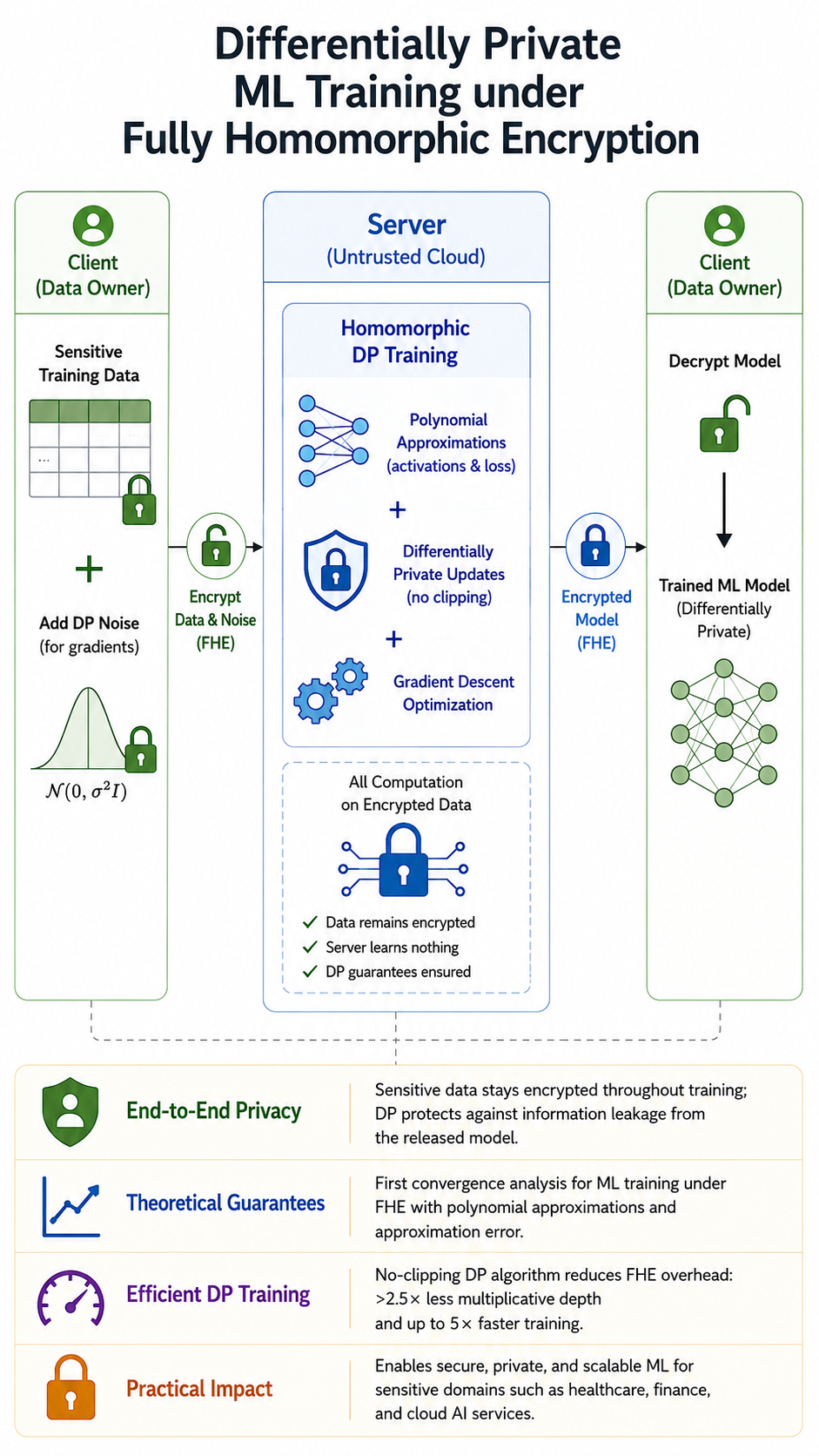
Differentially Private Machine Learning Training under Fully Homomorphic Encryption
Key Concepts: Fully Homomorphic Encryption (FHE), Differential Privacy, Secure Machine Learning, Optimization Theory
DP-ML Training on DP Synthetic Data
Key Concepts: Differential Privacy, Machine Learning, Synthetic Data

This project develops a preprocessing-based framework for Differentially Private Machine Learning (Pre-DPML), where models are trained on synthetic data that safely replicates key statistical properties of sensitive datasets. Instead of adding noise during model training, we adopt a select–measure–generate workflow: (1) select attribute sets as marginal queries, (2) privately measure their statistics by adding Gaussian noise under (ε, δ)-DP, and (3) generate synthetic data that matches these noisy marginals.
The resulting DP synthetic data enables training of any ML model with privacy guarantees by design, without modifying the learning algorithm. We theoretically bound the excess empirical risk between models trained on real and DP synthetic data and empirically show less than 1% accuracy loss on multiple public datasets. This approach offers strong privacy protection, reusable synthetic data, and high model utility— a practical alternative to traditional training-based DP methods such as DP-SGD and PATE.
Virtual Login in XR
Technologies: Unity, MongoDB, XR Interaction Toolkit, SHA-256, Raycasting

Virtual Login in XR reimagines user authentication by bringing the login experience into immersive extended reality (XR) environments. Instead of typing traditional passwords, users interact with virtual objects to create unique “virtual passwords.” The project introduces two innovative XR scenes — Diagon Alley and Memory Palace — that leverage spatial memory and object manipulation for secure and engaging authentication.
In Diagon Alley, inspired by the Harry Potter universe, users select specific bricks on a wall to set or verify their password. In Memory Palace, users authenticate by performing distinct movements (rotate, move, lift) on virtual objects in an apartment scene. Each interaction sequence is transformed into a string and securely hashed using SHA-256 before being stored, ensuring confidentiality and protection from reverse-engineering attacks.
By combining principles from cognitive psychology and cryptography, this project enhances memorability, reduces cognitive load, and demonstrates a novel, human-centered approach to authentication in immersive computing environments.
[ Diagon Alley Demo ] [ Memory Palace Demo ]